I believe I alluded in your FA journal that I was officially worn out.
I concede, essentially, and am giving you advice and going the hell away afterward (this is a lie, clearly I am going to still be 'here'). You owe me a drink in two years.
>>507
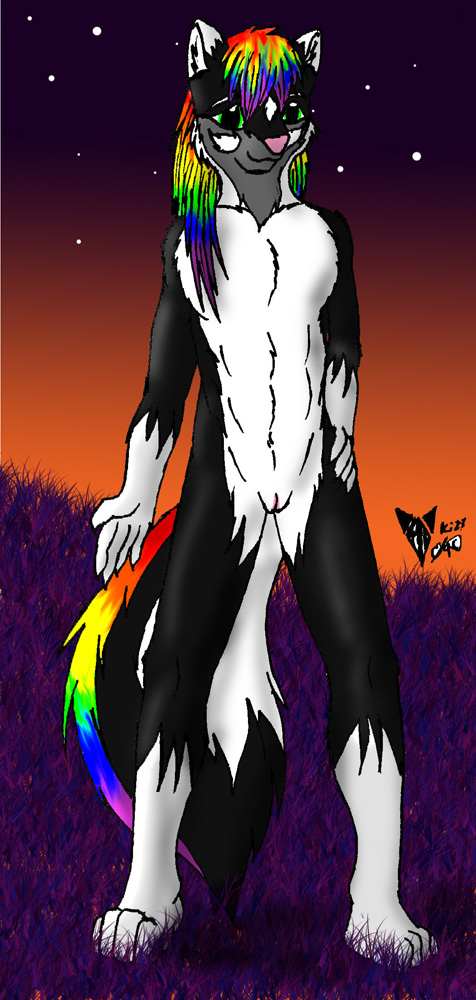
The problem with the lighting is that you do not have one set light source. You need to pick one - assuming you're sticking with the basics of one at the moment - and shade according to the form of the character. When dealing with cast shadows, the part that would be, say, the feet or body onto the tail, the further away the edge of the shadow is, the more diffused - or fuzzier - it gets.
In working with shadow, I would suggest dropping the color and just going with straight black and white. If you are able to work out how to effectively work without any half steps, smoothing things out will only be easier.
I would also suggest taking closer note of the spacing on the brush. One of the most annoying things to me is that 25% spacing thing going on. Lower it down as much as you possibly can, and strokes will be much smoother and more appealing.
>>530
To assume that there is no difference between this and the picture posted at >>525 is silly. There clearly is mild improvement. As much as I think you have potential for? Absolutely not.
This next part is going to be long:
The ears do not connect to the head properly. They are just 'symbols' of what you think ears should look like instead of thought out and anatomically sound ears.
Ultimately, if you want to choose to stylize eyes later on, you can do whatever you want, but you should learn how eyes work in the real world first, how they fit in the human skull and how they fit in the animal skull. The subtleties and roundness of them certainly makes something worthwhile of depiction. Emotion can be portrayed genuinely, and your stylizations will be better.
The muzzle looks somewhat haphazard, with the angle of the top of the nose varying drastically from the angle of the mouth itself. The entire thing does not match the angle of his head. He also lacks any sort of chin definition, so it seems like his mouth is coming out of his neck. The only thing I can really say for this is to look up photos of canines (or if you have one, have him sit around for a while as you study his head and how it connects to his neck from various angles), as well as studying how the human head connects to the neck.
I am not sure about the shoulders, but I am under the notion that you do not understand how the pectoral works alongside the deltoid and has a tendency to appear 'connected' to it on the flesh. Various medical diagrams outline the musculature rather well, and studying them is a fairly easy thing to do. Alternately, google old photos of Arnold Schqarzenegger, because it's simultaneously horrifying and educational.
The pecs seem like they are a little too large, and fairly flat. They do not follow the form of the ribcage underneath them, and seem to be in the midst of defying gravity. Large pecs will fall downward, and in fact will jiggle amusingly when not in use and a person is in movement.
Ribcage is inaccurate. Too short, and the various lines around the back (on our right) do not indicate where it ends. There is an unnecessary portion of flesh coming inward directly below where you have indicated the 'end' of the ribcage. It should not be there, rather, the oblique should be larger and higher and the chest should be larger and lower. There tends to be a small space in the middle where the waist is, and... that's generally about it.
There are a couple odd lines beneath the pectorals, which seems to be an indication of an unknown muscle somewhere between the abdominals and the serratus. Speaking of, there are no serratus anterior here. They're the ones that connect to the upper seven or eight ribs and follow them along the side.
As far as the abdominals... the navel seems a little high, usually is between the lowest set and the second lowest of the rectus abdominus, occasionally on the lowest ones.
And those seem oddly defined. Like perhaps there shouldn't be a line defining it, rather just mild shading. Even in really ripped people it generally looks a lot more like a solid piece than two separate ones.
As mentioned, the obliques are oddly shaped. They do not sit on the iliac crest the way they should, and the lines curving inward do not seem to follow how they generally should lead onto the pubic region.
The penis is probably too high, although I suppose that dogs have their junk closer to their stomachs and you could argue that it's an anatomically stylistic choice, and ultimately I don't care.
The definition of the muscle in the upper arm is incorrect. The top of the bicep does not connect under the deltoid right, and the 'back' of the arm that we see is lacking proper musculature. Given that his hands have their backs to us, the bicep should also be turned inward, and we would probably see a bit of the tricep. The entire portion might need to be a little longer.
Forearms are far too short. Cannot tell structure due to gauntlets.
Thighs are uneven and structurally unsound. His right is significantly longer than his left. Quad structure might need to be more visible on the outer portion. Thighs are not completely straight.
Knees are defined oddly. They lack the knee cap structure. Given that you have knees, studying them will be very, very easy. Take note of where the largest bulge of the cap is, how the flesh may form around it when you fold your legs at different angles.
His left calf is much longer than his right. The right has odd definition on it. Careful with the lines.
Can't really tell the ankle and downward stuff, again due to armor. There are also some length issues there.
The armor looks somewhat flat. The only thing I can really think of if you don't have a good reference is to find some paper and fold/bend it in such a way that it replicates the shape you're going for, and going from that. Alternately, find close images on google and reference from those. I am not sure about the shoulder pads, but gauntlets and bracers should be relatively easy to find.
So in short, yes, go back to the basics of anatomy. Study skeletal structure of humans, as well as digitigrade animals. And skulls. Skull work is some of the best stuff one can do inside the furry fandom, because having a recognizeable animal due to the head shape is one of the oddly highly valued things.
Musculature can look threatening and complicated, but it's really not. I've actually memorized names of muscles just by all the diagrams I look at when I do this stuff. Medical diagrams are good stuff. Do not feel that you need to instantly know all the nuances of musculature, as the finer points end up coming from life and motion studies. If it takes time, it takes time, just... keep working at it.
Fat tissue comes next, but that varies drastically depending on the body type you're drawing. Try to pay attention to it anyway.
Then how the flesh lays on top of all that mixture, and how it generally defines certain areas of the body.
Also, working on becoming familiar with your media will help you immensely as well. Become comfortable with making long, connected, smooth strokes with the pencil. Don't just use your wrist to make lines, throw your entire arm into it. If it requires drawing on a massive surface to get into the habit of using your whole arm, then make an effort to do so.
Make a series of values with the pencil, from the lightest to darkest or the other way around. Familiarize yourself with making these varying tones and blending them together without smudging a picture. Smudging... smudging can be used for certain surfaces, and I suppose it's got its uses otherwise if you're really experienced with it. I will generally use it as the understructure for more complex rendering.
At this point I've completely lost my train of thought processing and must close this book.
Soo...
Questions?
 reply to thread or open thread in full view
 thread contains a flash
 /
/ expand/shrink thread
 link to this post in full thread view
 reply to this post in the quick reply window
 reply to this post in full thread view
 report this post to the moderators
 No.507
507
No.507
507
 No.525
-
No.525
-  No.530
-
No.530
-  No.535
-
No.535
- 